The City Plan of Ephesus | Urban Planning of an Ancient Metropolis
The City Plan of Ephesus
The city plan of Ephesus reveals one of the most sophisticated examples of urban planning in the ancient world.
Ephesus was not only one of the greatest cities of the ancient Mediterranean world but also one of the finest examples of urban planning in antiquity.
Its marble streets, monumental temples, theaters, marketplaces, and residential districts reveal a civilization that mastered architecture, engineering, and city organization long before the modern era.
Even today, the layout of Ephesus allows visitors to walk through an ancient city whose streets, monuments, and public spaces still preserve the rhythm of daily life from two thousand years ago.
The Geographic Location of Ephesus
Ancient Ephesus was established between Mount Pion and Mount Coressos (modern Bülbül Mountain), extending westward toward the Aegean Sea.
Its strategic position made the city one of the most important commercial and cultural centers of the ancient world. In antiquity, Ephesus stood directly beside a busy harbor connected to Mediterranean trade routes.
Over centuries, however, the nearby Küçük Menderes River gradually carried silt into the harbor basin, pushing the coastline farther away and eventually contributing to the decline of the city as a major port.
Today, the ancient harbor lies several kilometers inland.
The Grid System of Ephesus
The city followed a carefully organized grid system inspired by Hellenistic urban planning principles.
Wide streets intersected at right angles, creating a logical and highly functional layout connecting the city’s religious, political, commercial, and residential areas.
This organized structure reflected the influence of the Hippodamian planning system widely used in Ionian and Hellenistic cities.
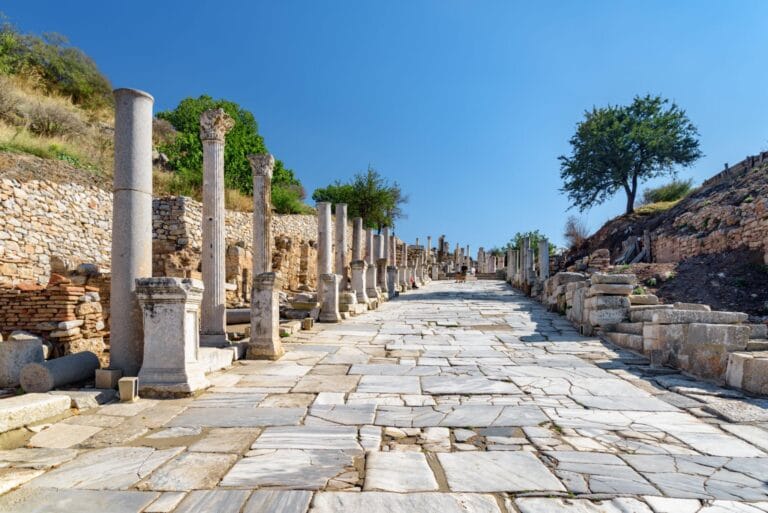
The streets of Ephesus were paved with marble and lined with columns, fountains, statues, shops, and public monuments, transforming the city into both a practical urban center and an impressive architectural showcase.
Curetes Street: The Heart of the City
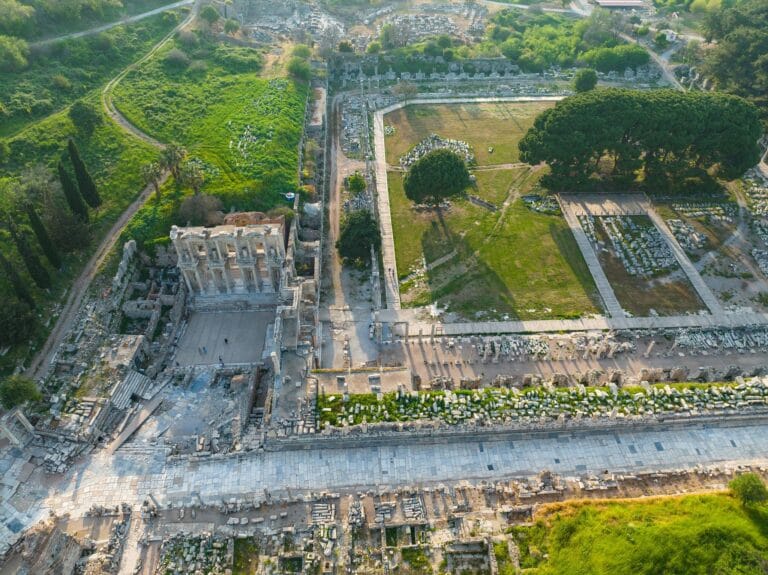
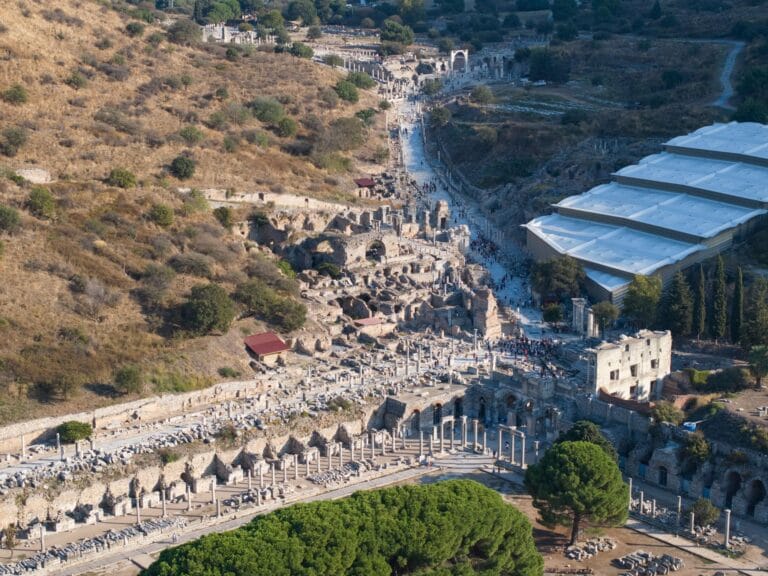
One of the most famous streets in Ephesus was Curetes Street.
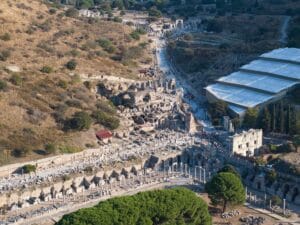
Stretching uphill from the Library of Celsus toward the Hercules Gate and the Upper Agora, Curetes Street formed one of the city’s main ceremonial and social arteries.
Along this magnificent marble-paved avenue stood some of the most important monuments of Ephesus, including:
• Temple of Hadrian
• Fountain of Trajan
• Monumental statues and honorific columns
• Public fountains
• Residential complexes
• Sacred buildings
The street itself symbolized the prosperity and elegance of Roman Ephesus.
The Marble Road and Harbour Street
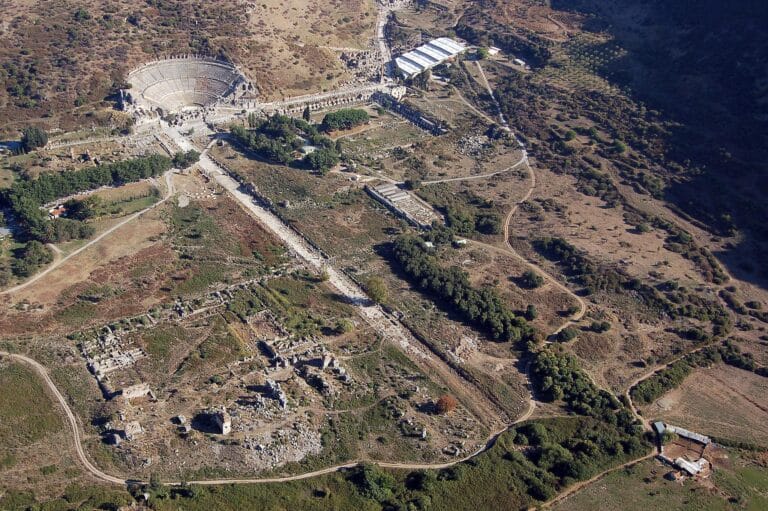
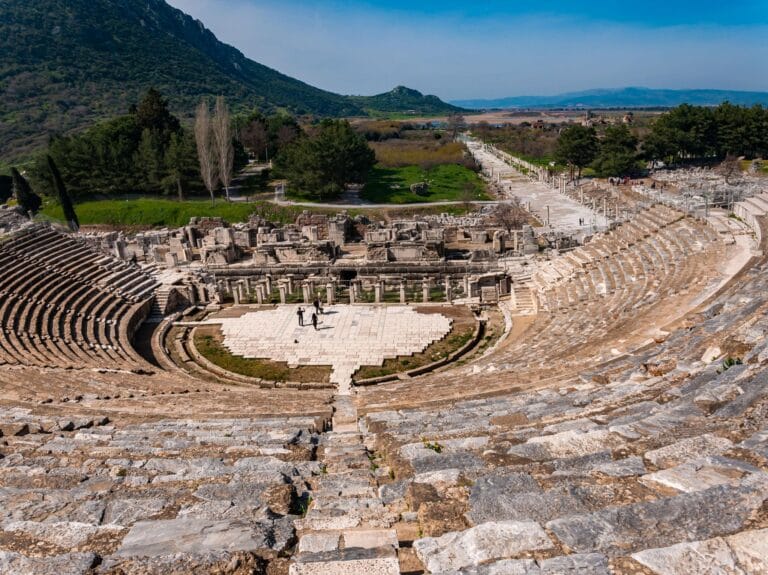
Another major urban axis connected the Great Theatre to the ancient harbor.
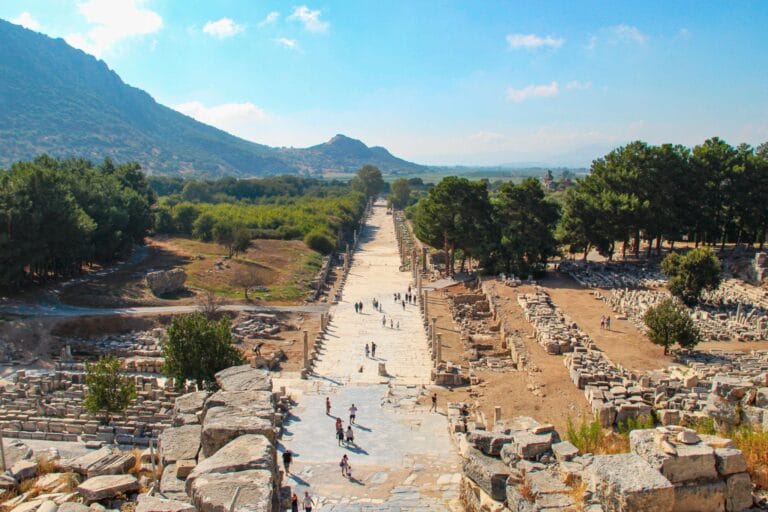
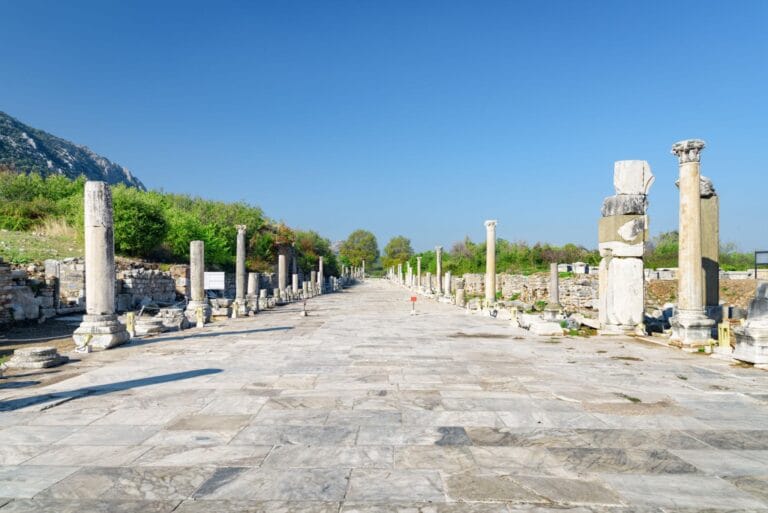
Known today as the Marble Road and Harbour Street (Arcadiane), this broad ceremonial avenue once welcomed merchants, travelers, sailors, and official processions arriving from the sea.
The alignment between the harbor, the Great Theatre, and the upper city created a dramatic visual perspective that emphasized the monumental scale of Ephesus.
At night, ancient sources suggest that Harbour Street was illuminated by rows of lamps, making it one of the most sophisticated streets in the Roman world.
The Agoras of Ephesus
Ephesus contained two major agoras serving different functions.
Commercial Agora
Located near the harbor, the Commercial Agora was the economic center of the city. Goods arriving from across the Mediterranean were traded here, making Ephesus one of the wealthiest commercial hubs of antiquity.
State Agora
The State Agora functioned as the administrative and political center of Ephesus. Government buildings, temples, and ceremonial spaces surrounded this important public square.
Together, these agoras demonstrate how carefully organized the city was in balancing commerce, governance, and religion.
Religious and Political Buildings
The city plan of Ephesus integrated religion deeply into civic life.
Among the important structures were:
Prytaneion
The Prytaneion served as the ceremonial heart of the city, where the sacred eternal fire of the goddess Hestia was maintained.
Odeon
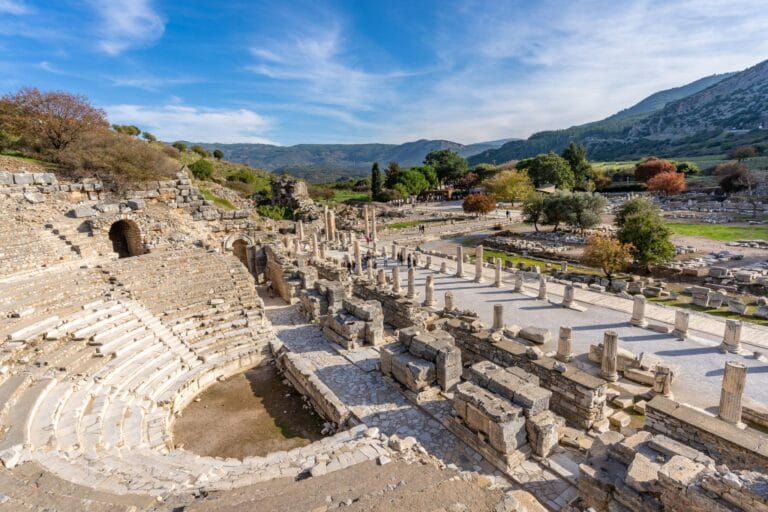
The Odeon was a small roofed theater used for political meetings, council gatherings, concerts, and public performances.
Temple of Domitian
One of the earliest temples dedicated to a Roman emperor, the Temple of Domitian reflected the growing influence of imperial cult worship in Ephesus.
The placement of these structures within the urban layout reveals the balance between politics, religion, and public identity in Roman society.
The Great Theatre of Ephesus
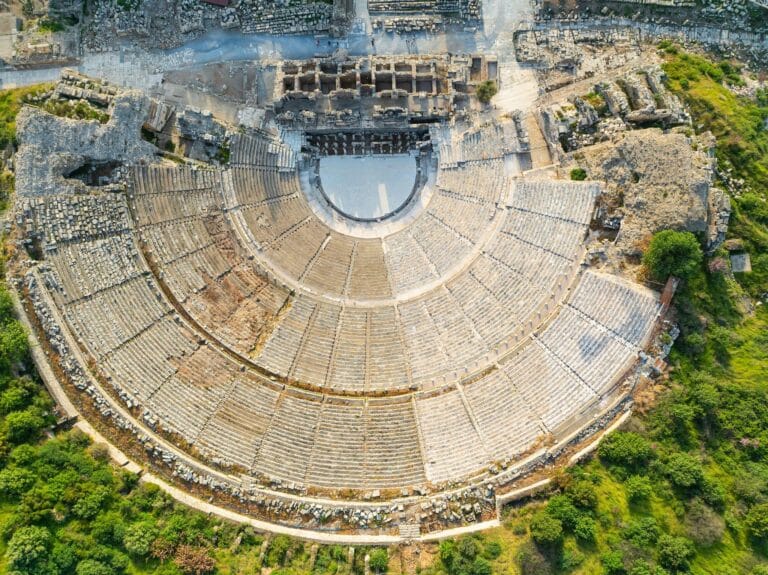
Built into the slopes of Mount Pion, the Great Theatre of Ephesus was one of the largest theaters in the ancient world.
With a capacity of approximately 25,000 spectators, it hosted theatrical performances, political assemblies, religious ceremonies, and public spectacles.
Its orientation toward Harbour Street was carefully planned. Visitors arriving from the port would immediately encounter the enormous theater rising above the city skyline.
This alignment created one of the most dramatic urban compositions in the ancient Mediterranean world.
Terrace Houses and Residential Districts
Above Curetes Street stood the famous Terrace Houses, luxurious homes belonging to the wealthy elite of Ephesus.
These multi-story Roman residences featured:
• Mosaic floors
• Fresco decorations
• Marble interiors
• Heating systems
• Running water
• Indoor plumbing
The residential planning demonstrates that comfort, technology, and aesthetics were major priorities in Roman Ephesus.
The city also included more modest residential neighborhoods, workshops, baths, and commercial areas supporting a large urban population.
Water Supply and Infrastructure
One of the greatest achievements of Ephesus was its advanced infrastructure.
The city possessed:
• Sophisticated drainage systems
• Aqueducts
• Public fountains
• Underground sewer networks
• Public baths
• Water distribution channels
These engineering systems helped maintain hygiene, support public health, and supply water to homes, fountains, and monumental buildings throughout the city.
Such infrastructure played a major role in allowing Ephesus to thrive for centuries as a major urban center.
Population and Urban Scale
Modern archaeological studies estimate that Ephesus covered approximately 415 hectares during its peak period.
The population may have reached between 250,000 and 300,000 inhabitants, making it one of the largest cities in the Roman East.
Its streets, monuments, and infrastructure reflected the needs of a cosmopolitan population composed of merchants, sailors, pilgrims, politicians, craftsmen, and travelers from across the Mediterranean world.
The Legacy of Ephesus Urban Planning
The city plan of Ephesus reflects far more than practical organization.
It reveals the vision of a civilization that sought harmony between architecture, religion, commerce, engineering, and human life.
Every street and monument was designed with intention — connecting temples, marketplaces, theaters, homes, and public spaces into a unified urban experience.
Even in ruins, Ephesus continues to inspire architects, historians, archaeologists, and travelers as one of the greatest planned cities of the ancient world.
Conclusion
The urban design of Ephesus demonstrates the extraordinary sophistication of ancient civilization.
From its marble avenues and monumental theaters to its advanced infrastructure and luxurious homes, Ephesus was a city where beauty and functionality existed together in perfect balance.
Today, walking through the ruins of Ephesus offers more than a journey into history — it offers a glimpse into one of humanity’s greatest achievements in urban planning and architectural vision.