Top Sights in Ephesus: 10 Incredible Places You Must See
Top Sights in Ephesus Ancient City You Should Not Miss
This ancient city is older than Rome…
Exploring the tTop Sights in Ephesus is one of the best ways to understand the rich history of ancient Anatolia and the Roman world.
Long before modern cities shaped the Mediterranean world, Ephesus was already thriving as one of the most important cultural, commercial and religious centers of antiquity.
Located on the western coast of Turkey near Selcuk and Kusadasi, Ephesus Ancient City remains one of the most impressive and well-preserved ancient cities in the world today. Once a thriving Greek and Roman metropolis, Ephesus offers visitors a unique glimpse into the past with its grand monuments, intricate mosaics, and fascinating history.
If you’re planning a visit, discovering the Top Sights in Ephesus will help you experience the city beyond its ruins and better understand why it was once one of the greatest cities of the Roman Empire.
Exploring the Top Sights in Ephesus Ancient City
1. Library of Celsus in Ephesus Ancient City
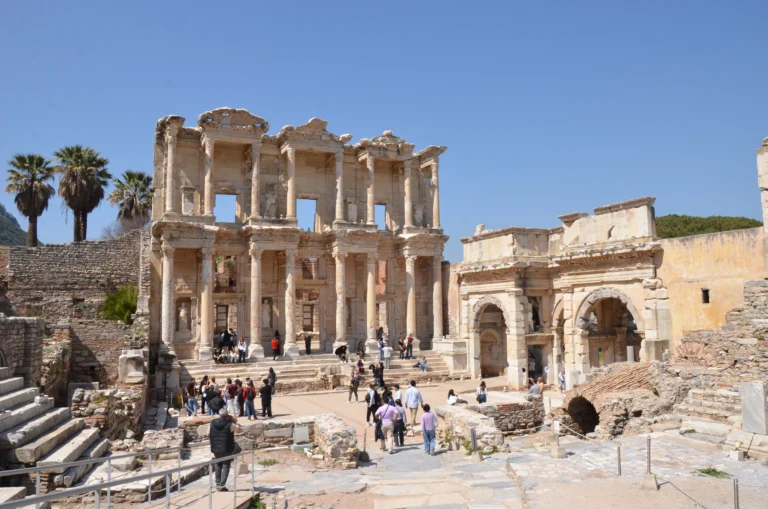
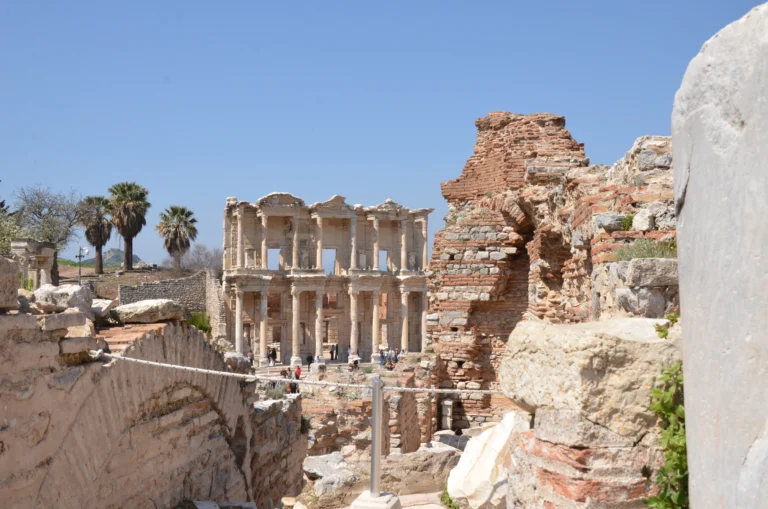
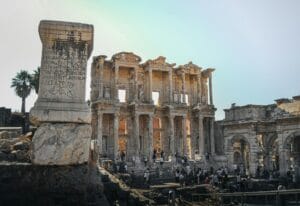
Perhaps the most photographed monument in Ephesus, the Library of Celsus stands as a masterpiece of Roman architecture and intellect. Built around 117 AD by Gaius Julius Aquila in memory of his father, Tiberius Julius Celsus Polemaeanus, the Roman governor of Asia, it once held more than 12,000 scrolls, making it the third-largest library of the ancient world, after Alexandria and Pergamon.
The two-story façade, with its Corinthian and Ionic columns, creates the illusion of grandeur through clever symmetry.
Statues representing Wisdom (Sophia), Knowledge (Episteme), Intelligence (Ennoia), and Virtue (Arete) once filled the niches between columns, symbolizing the values of learning.
Behind the façade lies a sarcophagus containing Celsus’s tomb; a rare honor, as Roman law usually forbade burials within city limits.
The library also faced the Agora, showing how learning and commerce coexisted in daily life.
2. Great Theatre of Ephesus
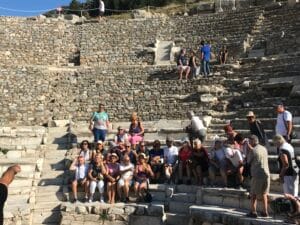
Carved into the slope of Mount Pion, the Great Theatre of Ephesus is one of the largest of the ancient world, capable of seating 25,000 spectators.
Initially built in the Hellenistic period (3rd century BC) and later expanded by the Romans, it hosted everything from dramatic performances to political assemblies and, later, gladiatorial games.
It was here that St. Paul preached to the Ephesians, as recorded in the Acts of the Apostles, causing a famous uproar among the followers of Artemis.
The theatre’s acoustics remain remarkable, a single speaker at the stage can still be heard clearly in the highest rows.
Climb to the top for a panoramic view of the Arcadian Street, once leading down to the now-vanished harbour.
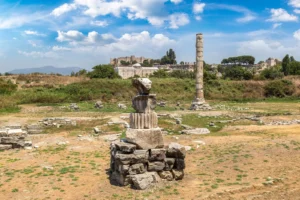
3. Temple of Artemis Near Ephesus
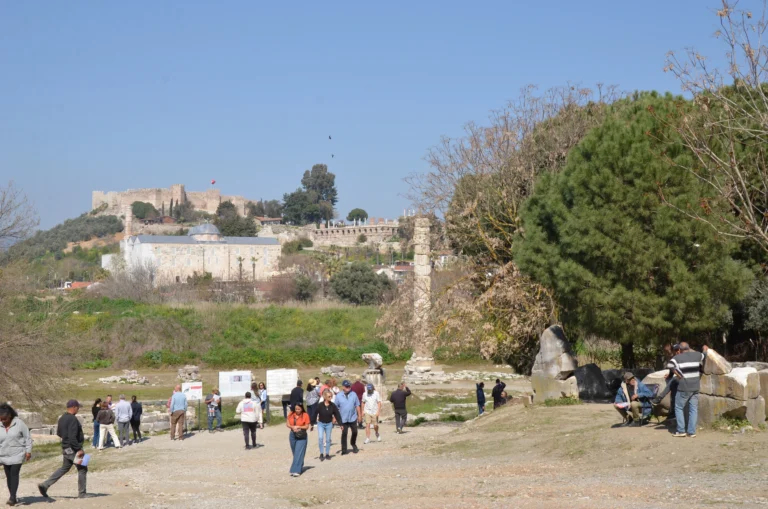
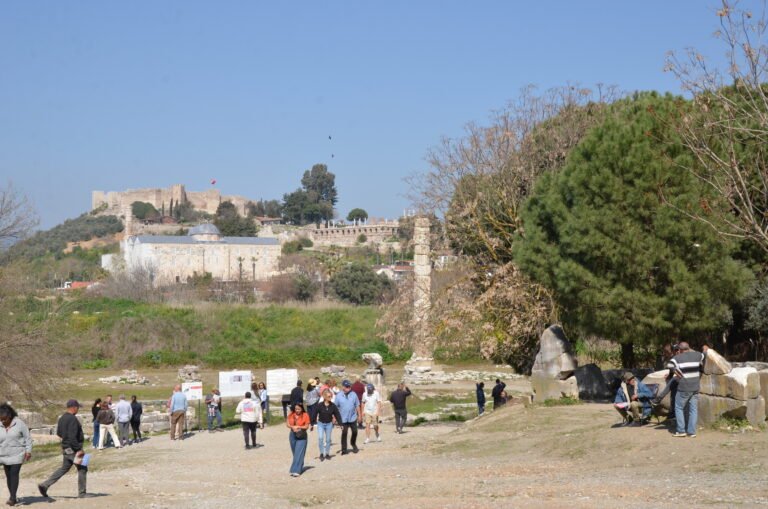
Once one of the Seven Wonders of the Ancient World, the Temple of Artemis was a magnificent structure dedicated to the goddess Artemis.
Today, only a single column remains, but its historical significance still attracts travelers from around the world.
For more historical information about the Temple of Artemis, you can also visit this page for the Themple of Artemis.
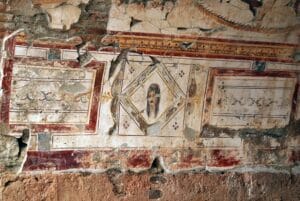
4. Terrace Houses
Located on the slope of Bulbul Mountain (Mount Koressos), opposite the Library of Celsus, the Terrace Houses reveal how the wealthiest citizens of Ephesus actually lived.
Ongoing conservation work allows visitors to walk along elevated glass platforms, viewing the ancient kitchens, dining rooms, and courtyards of the city’s elite.
These were not modest homes. They belonged to the city’s elite; merchants, officials, and prominent families. The interiors were richly decorated with marble wall panels, frescoes, and elaborate floor mosaics.
Instead of carpets, the Romans walked on mosaics. With the exception of kitchens and service areas, floors were covered in detailed designs. Some depicted mythological scenes; others showed figures such as Dionysus, Eros, lions, and even the philosopher Socrates. Daily life took place on top of storytelling.
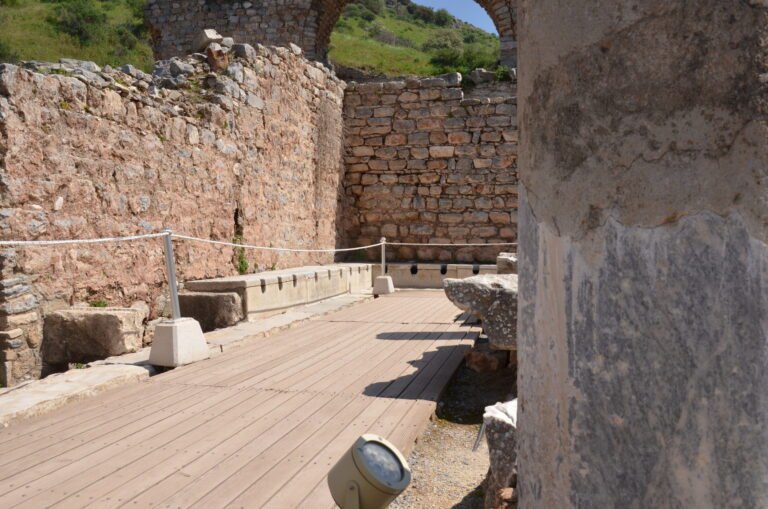
The houses were equipped with private heating systems, running water, and even indoor latrines connected to the city’s drainage network. Comfort was not improvised; it was engineered.
These residences reveal private life: taste, status, wealth, and the Roman understanding of domestic comfort. In short, this was not ordinary housing. It was ancient real estate at its finest.
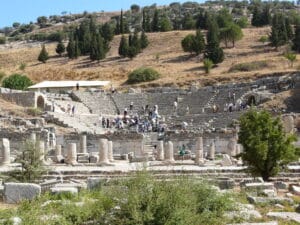
5. Odeon of Ephesus
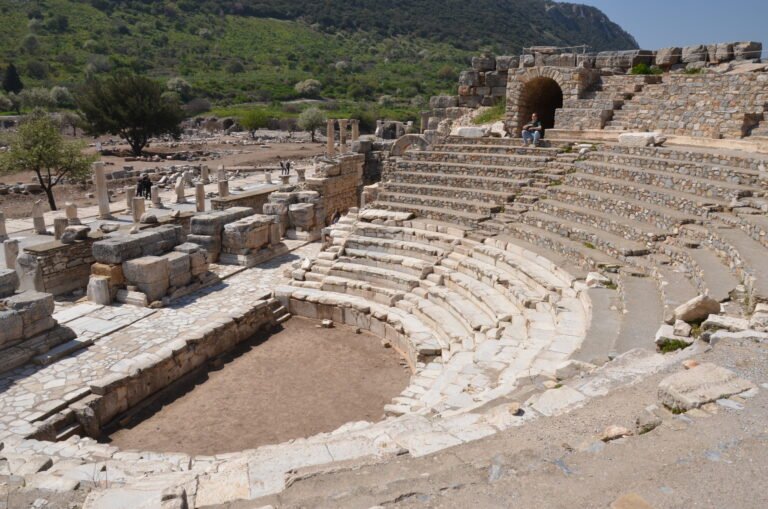
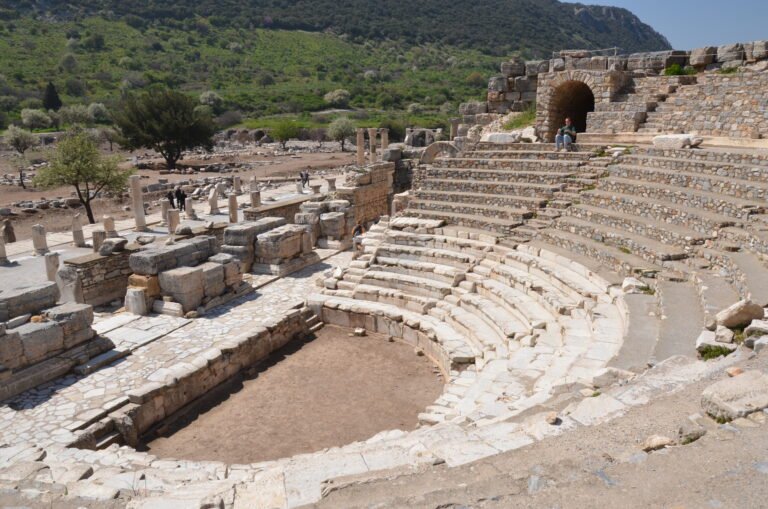
At the top of Curetes Street stands the Odeon, a structure that functioned both as a small theatre and as the city’s council chamber, known as the Bouleuterion.
Although it resembles a theatre at first glance, this was not a space for large public spectacles. Instead, it was one of the most important political buildings in Ephesus. From here, the city governed.
The Bouleuterion served as the meeting place of the Boule, often referred to as the Council of Five Hundred. Ephesus operated under a dual-council system, and the advisory council gathered in this building to discuss civic matters. Approximately 1,500 seats formed a semicircle facing a central stage, where magistrates and officials addressed the assembly. Laws were debated, taxes were determined, and administrative decisions were made within these walls.
Unlike the Great Theatre below, the Odeon was not open to the general public. It was reserved for political elites and officials. The building was originally roofed, creating an enclosed and controlled environment. Its acoustics were carefully designed so that every speaker could be clearly heard – a reminder that public speech and persuasion were central to Roman civic life.
Standing here today, one can almost imagine the low murmur of discussion echoing across the stone seats. The lion’s paw reliefs carved along the sides of the steps subtly reinforce the symbolism of authority and strength. It was in places like this that the practical, everyday decisions were made – the kind that sustained an imperial capital.
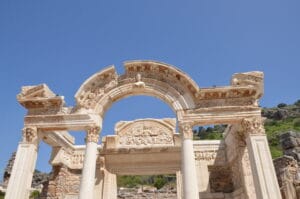
6. Temple of Hadrian
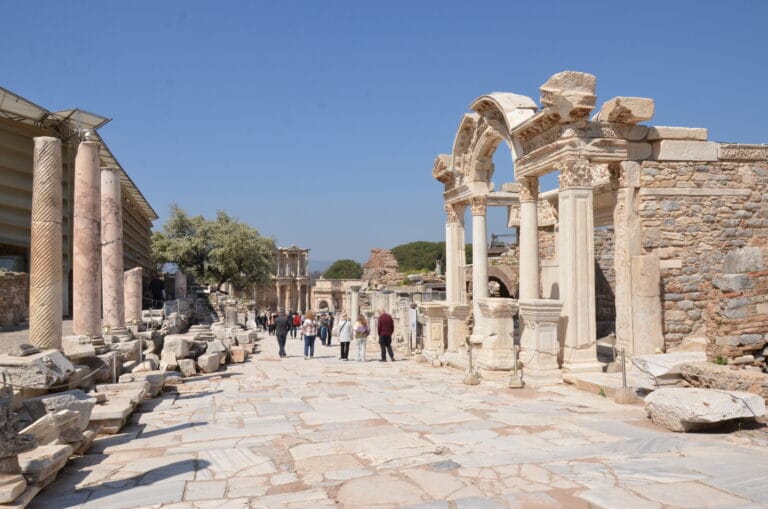
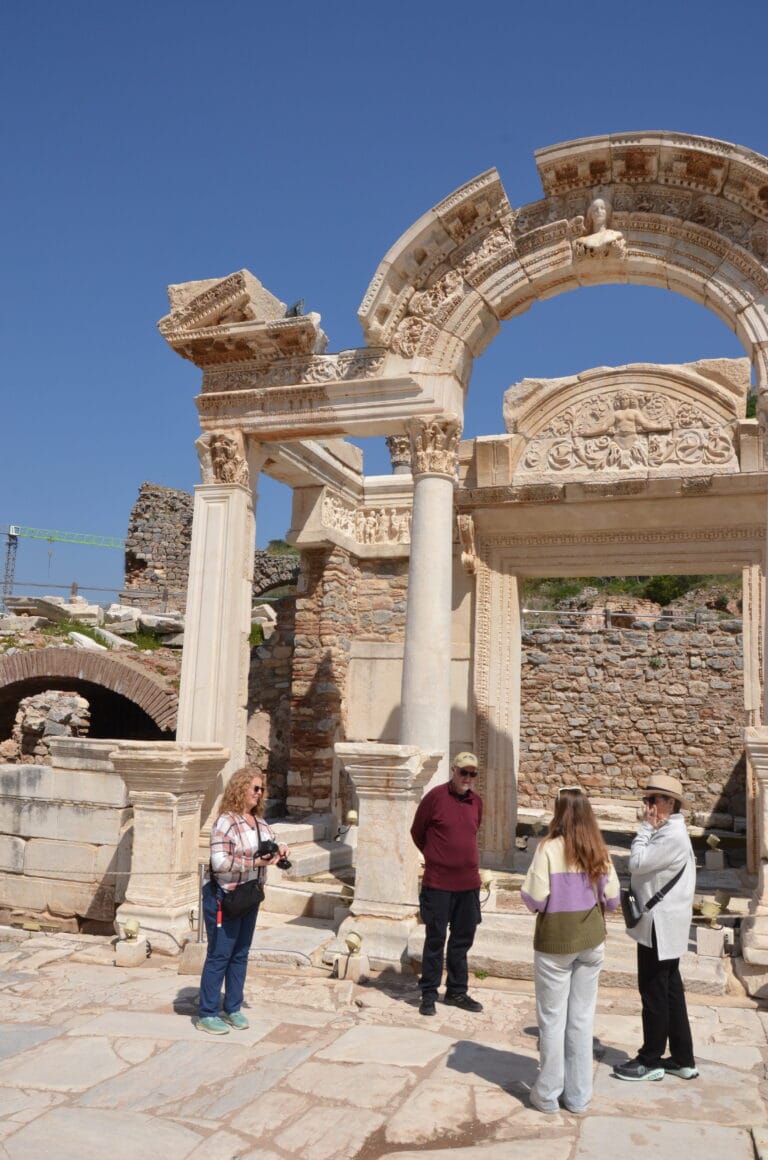
This elegant and compact structure along Curetes Street was built in honour of the great Roman Emperor Hadrian who brought peace and prosperity to Rome during his 21-year reign.
The façade, with its arch supported by Corinthian columns, features intricate friezes depicting mythological scenes of Ephesus’s founding including Androclus, the legendary founder, chasing a boar as the oracle foretold.
Despite its modest size, the temple is one of the best-preserved monuments in Ephesus, offering insight into Roman religious life and artistry.
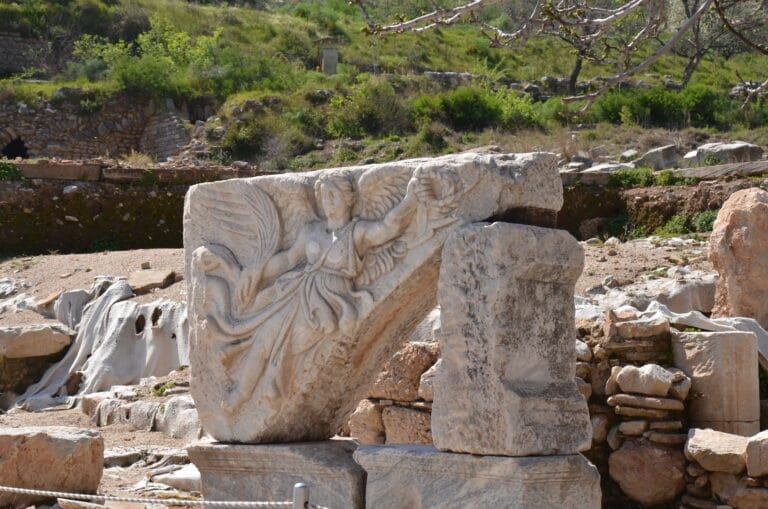
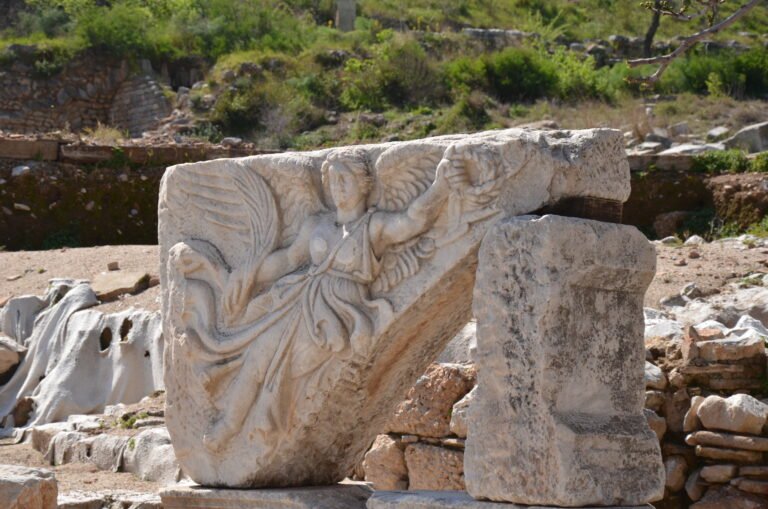
A detailed relief of Tyche, the goddess of fortune, adorns the arch, symbolizing prosperity and divine favor.
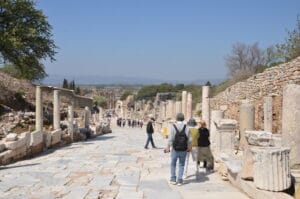
7. Marble Street
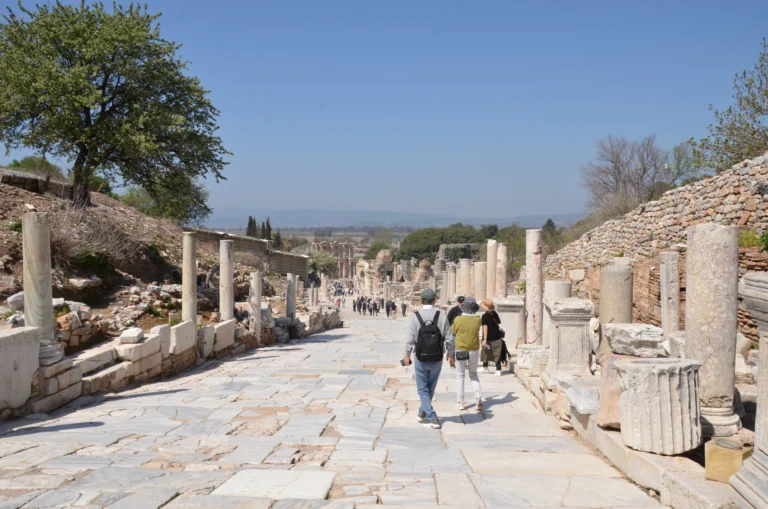
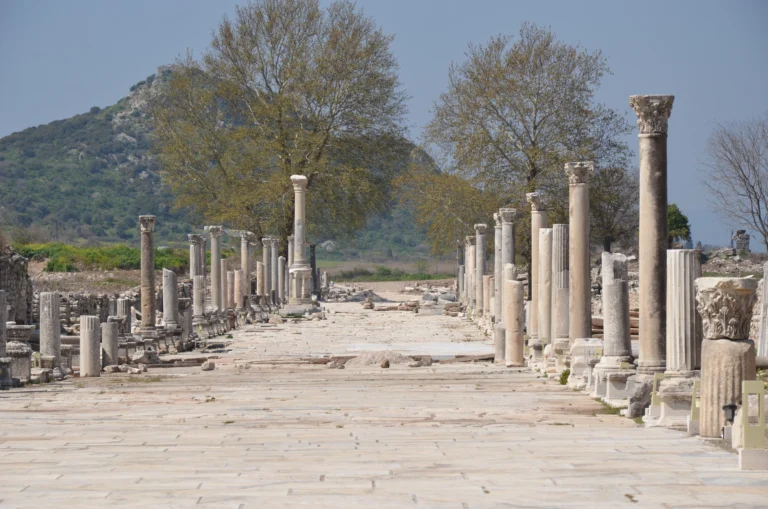
Walk along Marble Street remains one of the most memorable experiences in Ephesus. This ancient road, which once connected the Library of Celsus to the Great Theatre. The grooves in the marble, worn by centuries of chariot wheels, are still visible today.
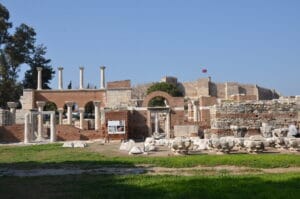
8. Basilica of St. John
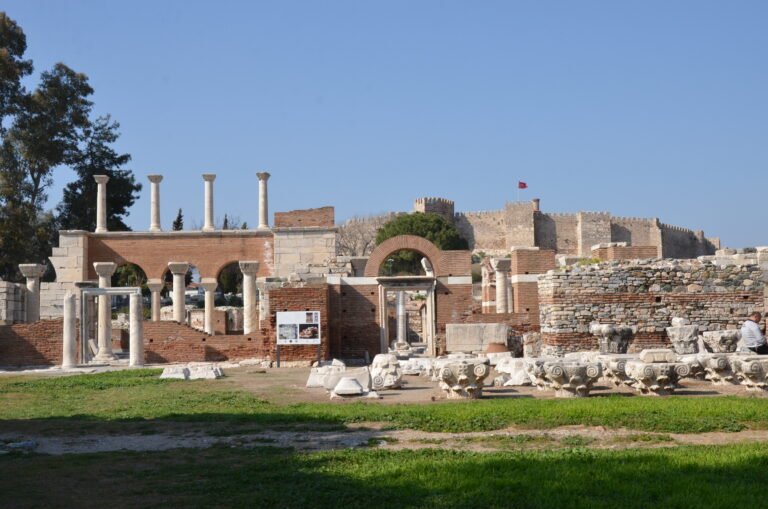
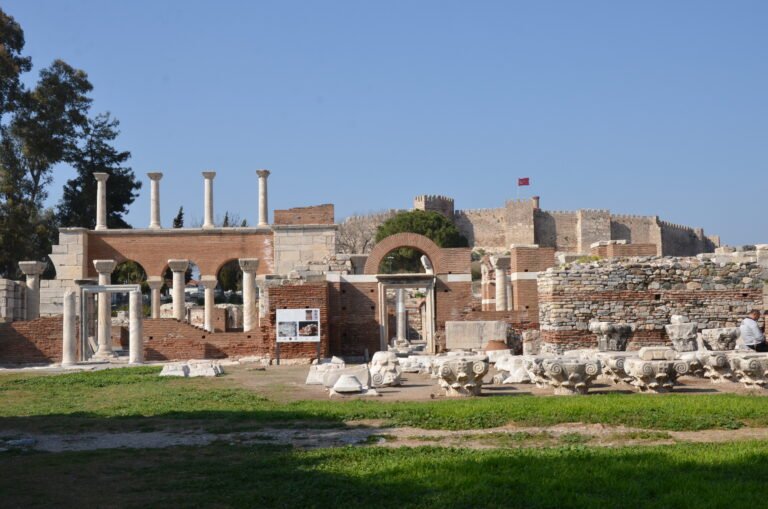
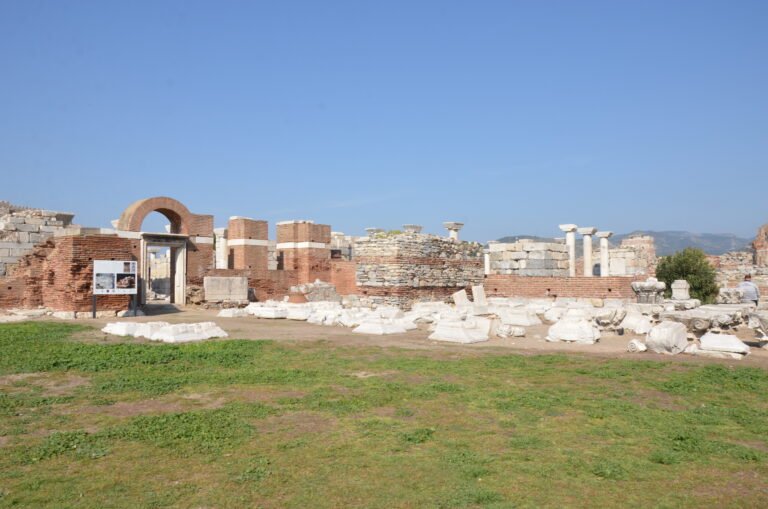
Located on Ayasuluk Hill, the Basilica of St. John was built in the 6th century AD and is believed to be the burial site of St. John the Apostle.
The panoramic views overlooking Selcuk and the surrounding countryside make this one of the most important religious sites near Ephesus.
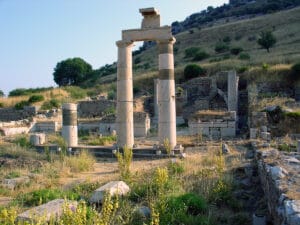
9. Prytaneion
The Prytaneion was one of the key public buildings of Ephesus. It functioned as both an official civic hall and the sanctuary of the city’s sacred fire.
In practical terms, it can be understood as a combination of a state reception hall and a ceremonial center. Official guests were welcomed here, foreign ambassadors were received, and important civic gatherings were held.
At its center burned the sacred fire dedicated to Hestia, the Greek goddess of the hearth. Her name literally means “hearth” or “fireplace” in Greek. In the ancient world, fire was essential for survival, and the hearth therefore became a symbol of life and continuity.
Every city maintained a sacred flame in her honor. In Ephesus, this fire represented the life of the city itself. The flame was kept constantly burning. Its extinction was considered a serious omen, suggesting divine displeasure or potential misfortune. Appointed civic officials were responsible for maintaining it.
Oaths were sworn before this sacred fire, and diplomatic agreements were concluded in its presence, giving political acts religious legitimacy.
Excavations in the Prytaneion uncovered two monumental statues of Artemis Ephesia, now displayed in the Ephesus Museum in Selcuk. Unlike the classical Greek image of Artemis as a huntress, her torso is decorated with multiple oval forms, commonly interpreted as symbols of fertility. Some scholars describe them as multiple breasts, while others argue that they represent bull testicles or symbolic elements associated with the Apasas bee.
The presence of these statues inside the Prytaneion demonstrates how closely civic authority and religious belief were connected in Ephesus.
In Ephesus, governance was divided between function and symbolism. Decisions were made in the Bouleuterion; they were represented and ritually affirmed in the Prytaneion.
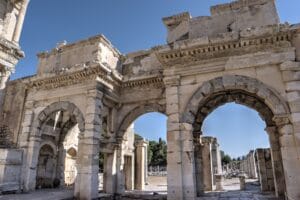
10. Gate of Mazeus and Mithridates
This monumental gateway once marked the entrance to the commercial agora of Ephesus. Dedicated to Emperor Augustus by two freed slaves, its grand arches and inscriptions reflect the city’s importance as a major trade and commercial center of the Roman world.
Why the Top Sights in Ephesus Still Fascinate Travelers Today
From the Library of Celsus to the Great Theatre of Ephesus, the top sights in Ephesus continue to amaze travelers from around the world.
Ephesus is far more than an archaeological site. It is a place where Roman history, mythology, early Christianity and everyday ancient life still feel remarkably alive among the marble streets and monumental ruins.
Whether you arrive from Kusadasi Cruise Port, Selcuk, Izmir, or Istanbul, exploring the Top Sights in Ephesus offers one of the most unforgettable historical experiences in Turkey.
You may also enjoy reading our related articles about:
- Best Ephesus Shore Excursions from Kusadasi
- Half Day Ephesus Tour from Kusadasi Cruise Port
- Ancient Cities in Turkey You Should Visit